
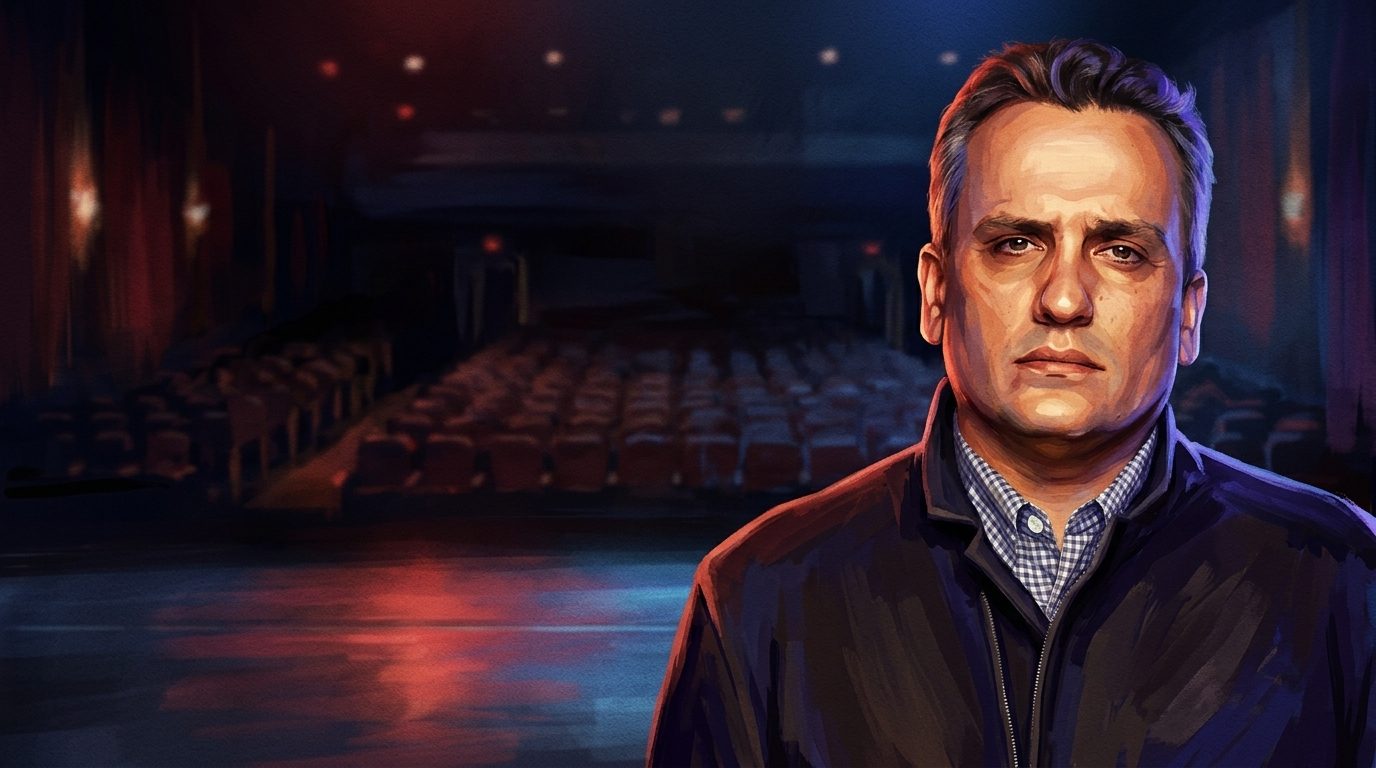
Doctor Doom’s motivation in Avengers: Doomsday is grief, and Marvel moved it one generation down. In the comics, Doom spends his life trying to pull his mother’s soul out of hell. In the film, he is a father who has lost a child.
Robert Downey Jr. plays Doom, and Kevin Feige has closed off the theory that would have made the loss a shortcut: Doom is not a variant of Tony Stark. Avengers: Doomsday opens Dec. 18, the same day as Dune: Part Three, with domestic presales past $50 million three months out.
Spoiler Warning
This spoils the post-credits scenes of The Fantastic Four: First Steps, Avengers: Endgame Encore and VisionQuest, plus trailer lines for Avengers: Doomsday.
What the Russos Said
“Doom is a Gothic character,” Joe Russo told Empire. “He says, ‘Hell answers to me,’ and he’s not kidding. He’s a very powerful character with some very dark magic, and he’s not above selling his soul to get what he wants. He’s worth being scared of.”
https://x.com/empiremagazine/status/2120924593179521181
Then came the rewrite. “He’s a father who’s a victim of trauma. He has lost a child,” Russo said. “When people see the film they say it’s a very scary movie. It’s scary because he’s so profoundly damaged.”
Anthony Russo supplied the contrast with the last big bad the brothers directed. “Doom is much more ego-driven than Thanos,” he said. “Thanos believed he was serving a greater good.”
Downey’s account of the turn is the least reverent line in Empire’s package. “Remember Michael Douglas at the end of Falling Down? He goes, ‘I’m the bad guy?’ I had that realisation a couple of days into shooting, because all the heroes are over there, and I’m the problem,” he said, before leaning into it. Feige’s answer on the variant question was blunter still: “Is Steve Rogers a Johnny Storm variant? People wondered, ‘Is Doom just a variant of another character? Is this just a shortcut to bringing back another character?’ The answer is no. He’s Victor Von Doom.”
What the Swap Gains
“Damaged” is an easier sell than “powerful.” Marvel usually advertises villains by what they can do, stop a hammer, command an army. Fear built on a wound is harder to punch, which is part of why it works here.
It also separates Doom from Thanos, who is also technically a grieving father. Thanos sacrifices his daughter for the Soul Stone on Vormir and calls it arithmetic, a debt paid. Doom loses a child to something he could not stop and calls it theft. One villain thinks he settled an account. The other thinks the account was robbed, which is where Anthony Russo’s line about ego earns its keep.
The change also plugs Doom into imagery the film already has. The trailer line “He used to be different,” spoken by Sue Storm, and Collider’s report of a painting of a woman holding a child in Doom’s castle both now read as pointing somewhere new. His trailer line “All of you have lived stolen lives” lands as a father’s complaint: everyone else got their people back.
What the Swap Loses
The bargain is gone. Marvel’s official guide has Cynthia von Doom trading her soul to Mephisto to protect her people, her soul dragged to hell, Victor’s face scarred in the experiment he ran trying to reach her. That story has an opponent in it, a devil to out-argue, a contract with a name on it. A dead child has nobody to negotiate with. Russo says Doom is not above selling his soul, but a sale needs a buyer, and the father premise removes the thing he would be buying back.
The guilt is gone too. The same guide records Doom sacrificing Valeria, “the one-time love of his life,” for power, then wearing a suit made from her skin. Comics Doom’s losses are usually invoices for his own choices. “Victim of trauma” voids the invoice, and with it the trait that separates Doom from every other wounded man in armor.
It goes further back than Mephisto. Doom’s father Werner dies of exposure trying to keep young Victor warm after the two flee Latveria, which makes the comics version an orphan twice over before he is ever a villain. The film’s rewrite moves that wound from having no one to losing someone, and it is a smaller wound either way.
Three Teases, One Pattern
- The Fantastic Four: First Steps. The mid-credits scene jumps four years, and when Sue Storm returns to young Franklin Richards, Doom is already beside him, hood up, mask in hand.
- Avengers: Endgame Encore, re-released Sept. 25, 2026. Doom breaks into Bruce Banner’s facility and tells him he is “here to collect you”, and the last tag shows him forging his mask.
- VisionQuest’s finale. In the post-credits scene, Doom reaches Wanda Maximoff at Mount Wundagore: “Scarlet Witch, awaken. Your power will be mine.”
None of the three is a mourning scene. Each is an acquisition. That is the practical case for the rewrite: a father who lost a child and now collects other people’s power gives a film something to stage in every act without stopping for a flashback.
Grieving Father or Grieving Son
Den of Geek’s Joe George worried in June that talk of brand-new storytelling might sand off Doom’s third-person grandiloquence and his hatred of Reed Richards. The father rewrite does not touch those traits directly, but it changes what the audience is invited to feel. Pity now sits close to the surface of the character.
As a movie villain, the father is the stronger build. He needs no demon, no hell dimension, just one sentence and a mask that hides more than a scarred face. Downey’s own summary of the job, a man discovering he is the problem, is the note the Russos keep hitting.
As a character, the son was the richer one, because his grief arrived attached to a contract, and Doom’s defining trait was never that he suffered. It was that he refused the terms. A grieving father can carry a movie. A grieving son carried a mythology.