
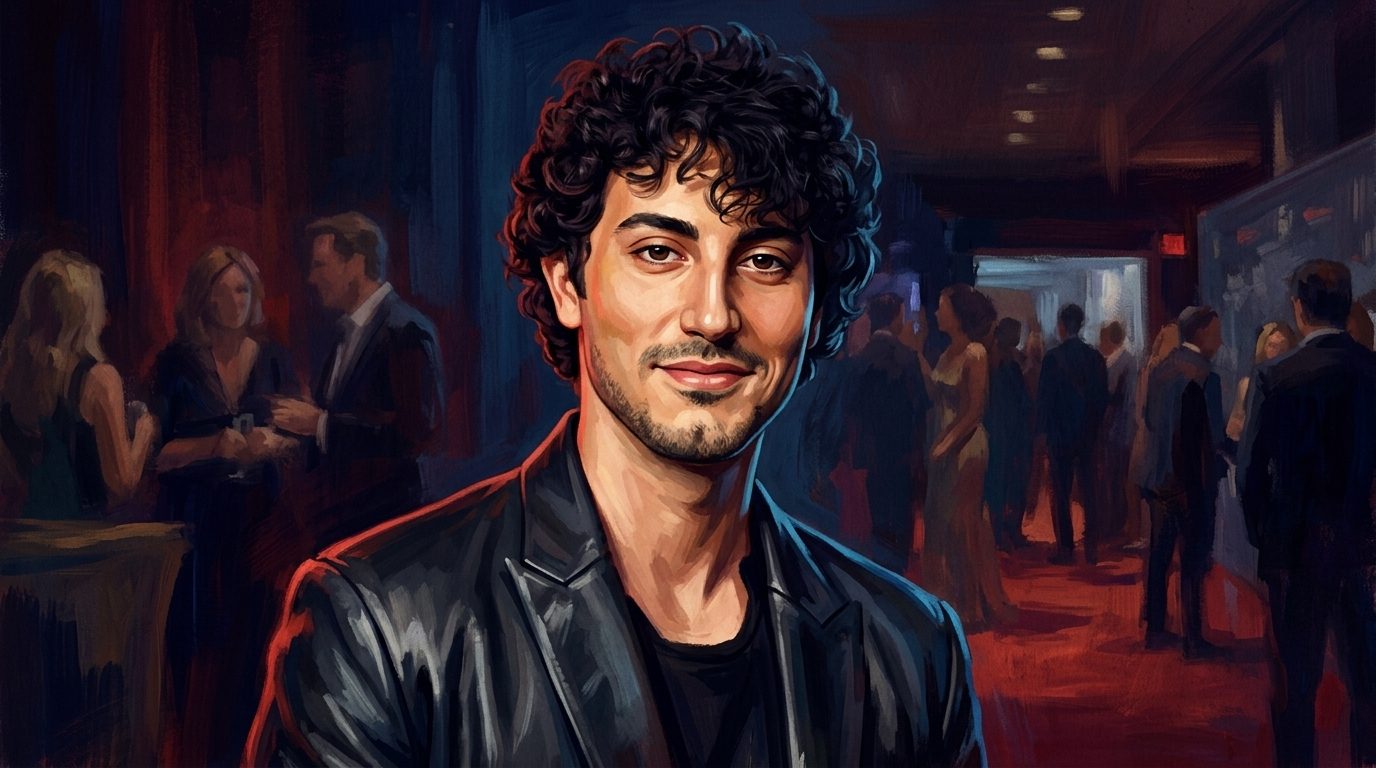
I Play Rocky deserves a trip to a theater, though almost everything that moves there was built by somebody else first. Peter Farrelly’s account of how Sylvester Stallone talked a reluctant studio into letting him star in his own screenplay runs on secondhand feeling throughout: the laughs are pre-loved, the lump in the throat is on loan from 1976, and the finale works because the real finale worked fifty years ago. What survives the borrowing, and what makes the ticket worthwhile, is Anthony Ippolito, who plays Stallone with a voice and a posture exact enough to be an achievement of its own.
The borrowing is not subtle, and the film does not pretend otherwise. Stephan James walks in as Carl Weathers, afro and open denim shirt, and the scene works mainly because the audience already loves that face. P.J. Byrne, as producer Irwin Winkler, hears a sample of what will become the Rocky theme and shrugs it off, and the joke lands on the audience’s hindsight rather than anything the scene has earned. Max Weiss at Baltimore Magazine named the feeling precisely, asking whether there is a “cinematic equivalent to stolen valor” before landing on “rousing, entertaining, and a little too familiar.” Bill Goodykoontz’s line on the film’s Rotten Tomatoes page makes the same case from the other direction: “even second-hand inspiration is better than none.”
Ippolito’s performance is the one choice in this movie that was not available for borrowing, and it carries the whole picture on the strength of two decisions. The voice does the early work, a low rasp pulled from the back of the throat with the words slurring out slow, which Owen Gleiberman at Variety called “a miraculous act of channeling.” The walk and the stillness finish the job: Weiss clocks the hooded eyes, the loping walk and the coiled posture, and concludes flatly that “Ippolito is Stallone who is Rocky.” Billy Penn’s Davis Cuffe went looking for a prosthetic and found none, which makes the resemblance a performance rather than a makeup job. The one scene where the mimicry actually becomes acting comes on the Philadelphia set, when John Avildsen (Jay Duplass, nicely exasperated) tells Stallone the Mickey speech is not landing and makes him do it again, and the film shows him finding the anger by reaching for his own father instead of the script, an ad-lib Deadline singles out as the movie’s emotional knockout. For about ninety seconds the impression drops and something that looks like real feeling takes over, which is the closest the film comes to justifying its own premise.
The trailer sells that transformation in motion better than any paragraph can describe it. https://www.youtube.com/watch?v=V_g_Ut0jO-0
The trouble is that most of the film keeps asking the audience to supply feeling the screenplay has not earned on its own. Mark Hanson at Slant called the impersonation, once the novelty wears off, “little more than a party trick,” and David Rooney’s verdict at The Hollywood Reporter is the fairest sentence anyone has written about the movie: “a big-hearted movie about moviemaking, if not an artful one.” Cuffe is also right that the cinematography carries the flat gloss of a streaming title rather than the grime Rocky was proud of, a strange note for a movie whose entire argument is about honoring scrappiness (the irony seems to have escaped everyone involved except the critics covering it).
The film is oddest, and least honest, about money. It turns producers Irwin Winkler and Robert Chartoff (Toby Kebbell) into exasperated patron saints of independent filmmaking, a generous reading of two men who spent the actual shoot dodging the unions. The Hollywood Reporter notes that Stallone had no hand in this production and will not see a dollar from it, and that he publicly blasted Winkler in 2022 for never giving him an equity stake in the Rocky franchise he built. The real Winkler, 95, turns up in the film’s cameo anyway, while Chartoff, who died in 2015, gets the sympathetic treatment the screenplay withholds from the living man. Amazon MGM has made a habit lately of this kind of safe, true-story prestige, the same instinct running through its heist drama How to Rob a Bank, and both films would rather celebrate a legend than audit it.
Farrelly’s filmography makes this a strange, late turn for him. He won two Oscars for Green Book, made two broad comedies with his brother Bobby in Dumb and Dumber and There’s Something About Mary, and more recently turned out The Greatest Beer Run Ever and Ricky Stanicky. I Play Rocky is his most restrained work since Green Book, and it shares that film’s weakness for letting a true story argue its own case instead of earning the argument scene by scene. Gleiberman compared its spirit to Richard Linklater’s Nouvelle Vague, about the making of Breathless, and Pete Hammond at Deadline reached for Truffaut’s Day for Night; the comparison flatters the film more than it deserves, since neither Linklater nor Truffaut needed an actor this good just to carry a tribute this thin. Stallone’s own insistence on casting a relative unknown, the same instinct every filmmaker chasing an iconic role eventually faces, as Denis Villeneuve is currently discovering while he keeps pushing the gas on a Bond search without a name attached, turns out to be the smartest note anyone gave this production.
Anyone who already knows the Rocky legend beat for beat, the offer Stallone refused so he could star, the dog he sold and bought back, will spend two hours being told what they already own. One anonymous line on the film’s Rotten Tomatoes page gets at that exhaustion directly, calling it “the trivia page on IMDB being dramatized by actors.” That viewer should wait for streaming. Everyone else has a real reason to go: the film opened in seven theaters to a $48,209 per-theater average and expands to 27 more locations on Nov. 13 ahead of a nationwide release on Nov. 20, so the qualification stands alongside the recommendation. I Play Rocky is a tribute act with one performer who stopped impersonating long enough to act, and that performer is the whole case for buying a ticket.