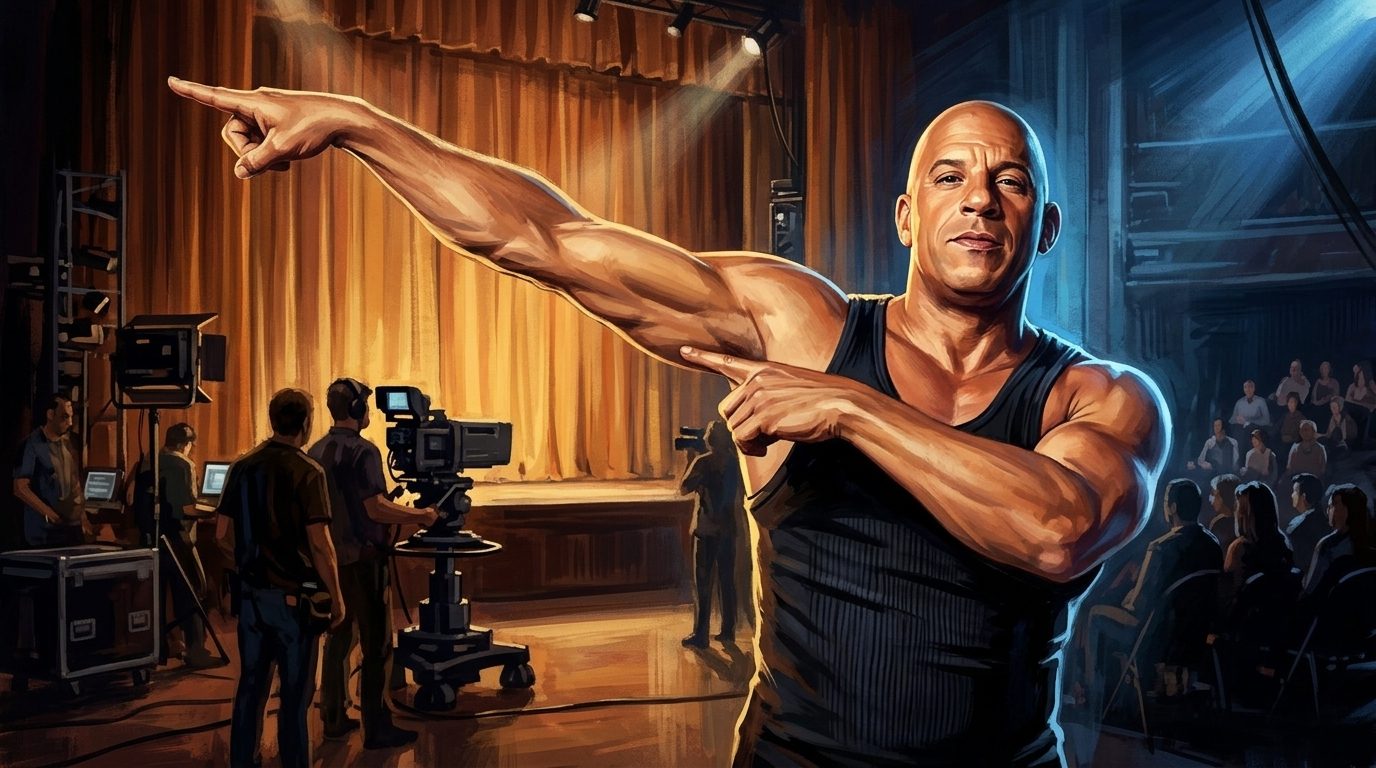

Yes, Focker In-Law is quoting Tropic Thunder, and it does it without ever saying the title out loud. Greg Focker (Ben Stiller) gets his face scorched in a kitchen standoff, then gets talked into a cold plunge that nearly finishes the job, the same hot-to-cold punishment Tugg Speedman survives in the fake Scorcher VI trailer that opens Stiller’s 2008 comedy.
Both gags land early in the film, well before any emotional reconciliation is earned. Nobody in the movie mentions Tropic Thunder, Tugg Speedman or Scorcher anything. The joke is built into the choreography, not the script.
Spoiler Warning
What follows describes two early set pieces in detail: the kitchen fire fight between Greg and Olivia (Ariana Grande), and the cold plunge with Jack Byrnes (Robert De Niro). Nothing from the film’s final act is discussed.
The Trailer Being Rhymed With
Tropic Thunder, the 2008 film Stiller directed and co-wrote, opens with a run of fake trailers for movies starring its own fictional actors. Richard Corliss wrote in Time that those opening trailers are “hilarious and devastatingly acute,” and the sharpest of them belongs to Speedman, Stiller’s washed-up action star.
Earlier Scorcher entries had Speedman saving a baby in the middle of a fiery apocalypse. Bill Bria’s SlashFilm breakdown lays out what Scorcher VI: Global Meltdown does next: an eclipse plunges the post-apocalyptic Earth into freezing temperatures, and Speedman returns to look after two babies instead of one. Fire, then ice.
Focker In-Law runs the same swing in the same order. Greg and Olivia both want the kitchen to cook for Jack’s 80th birthday, and the standoff ends with a flame hitting Stiller’s face hard enough to leave him scorched. Then a wellness-converted Jack insists the two men talk things out in a cold plunge, where Greg claims he has done this before. He has not.
The Rule Greg Focker Always Pays For
Bria names the actual mechanism running under both gags: “one of the tenets of the ‘Meet the Parents/Fockers’ franchise is that Greg needs to be put through the ringer both emotionally and physically,” he writes. The series has never been about whether Greg wins Jack over. It is about how much it costs him physically to try.
Frank Scheck’s Hollywood Reporter review, which is otherwise not kind to the film, agrees on the engine even while disliking the car. He writes that the comic set pieces “nearly all revolve around humiliation.” That has been true since the first film. What changes with the Scorcher nod is that the humiliation now has a franchise joke attached to it.
How Hamburg Built the Punishment for Real
John Hamburg, who wrote the first three films and wrote and directed this one, did not fake the heat. The flame that hits Stiller’s face came from a practical special-effects rig rather than a digital add, and Grande took multiple knife-skill lessons from the sous chef at Blue Hill at Stone Barns so the kitchen choreography would hold up. Hamburg described the contact getting negotiated in real time: “Ben was saying, ‘Swat me in the face,’ and Ariana was saying, ‘Put your hand on my face to push me away!’”
The commitment had a cost elsewhere in the shoot. Stiller told The Graham Norton Show he passed out filming the dinner scene where Greg chokes and Olivia performs the Heimlich, a story Cover Media reported and Yahoo carried: “I held my breath so hard that I actually stopped breathing and then passed out. Nobody knew because they thought I was acting!”
The cold half of the tribute was gentler, for one of the two men in the water. De Niro’s own account of the plunge undercuts the scene’s danger on purpose: “Back in the day I would have insisted on freezing water, for this I insisted on 80 degrees.” Stiller takes the burn and then the chill. His scene partner negotiates his way to something closer to a warm bath. That asymmetry is the whole joke in miniature: Greg absorbs it, everyone around him does not.
Why Hiding the Joke Works Better Than Saying It
A line of dialogue would have been the easy version, a poster on a wall or a knowing reference to Tugg Speedman. Bria’s case is that burying the nod in stunt work instead makes it sharper: “It’s subtle enough to be missed yet clever enough to stand out.” Speedman survives a frozen planet. Greg cannot survive a spa day. The gap between those two outcomes is funnier without a caption explaining it.
A Better Legacy Sequel Than 29% Suggests
Focker In-Law sits at 29% on Rotten Tomatoes from 85 reviews as of Nov. 26, with a critics’ consensus that calls Grande “a bright and funny addition” while writing off the rest as an exhausted reunion. Set against the rest of the series, the number lands strangely:
- Meet the Parents (2000): 85% from 148 reviews
- Meet the Fockers (2004): 39% from 158 reviews
- Little Fockers (2010): 10% from 147 reviews
- Focker In-Law (2026): 29% from 85 reviews
The fourth film is not the series low, and not every critic treated it as an exhausted reunion. Glenn Kenny’s review for RogerEbert.com, carried on the film’s Rotten Tomatoes page, was more forgiving in tone than most of the pack and direct about why: “As the founder of this website reminded his fellow critics, when you laughed at a movie, you’ve got to tell your readers that you laughed. Readers, I did.”
What the film does well, better than most legacy sequels manage, is keep its original lead in the center of the frame instead of handing the franchise over to the kids. Greg is now roughly the age Jack was in the first film, and he fails at fatherhood the way Jack once failed at trust. Hamburg called it “a full-circle moment,” and that idea is the one this script actually earns, a point this site’s review of the sequel also lands on.
The money agrees the machine still runs. Deadline had the film at $5.2 million for its Wednesday opening, with a three-day estimate of $24.8 million and a five-day estimate of $36.1 million across 3,382 theaters, on a $90 million net production split between Universal and Paramount. The franchise had already banked $1.16 billion worldwide across its first three films before this one opened, a number worth weighing against the harder read on its critical reception.
The case against the film is real. The Hollywood Reporter called it “Focking awful,” and The Guardian found the whole thing marked by “a depressing sense of overfamiliarity.” Both are fair readings of a fourth installment that leans on a formula the series has been running since 2000, now showing up again 16 years after Little Fockers.
A 29% score measures how tired the machinery looks from the outside. It does not measure whether the hundredth pratfall still lands, and on the evidence of the kitchen fire and the cold plunge, it does. Focker In-Law exists to watch Greg Focker get hurt on a schedule, burned in one scene and frozen in the next, the way Stiller once got hurt on a fake poster for a movie that never existed.