
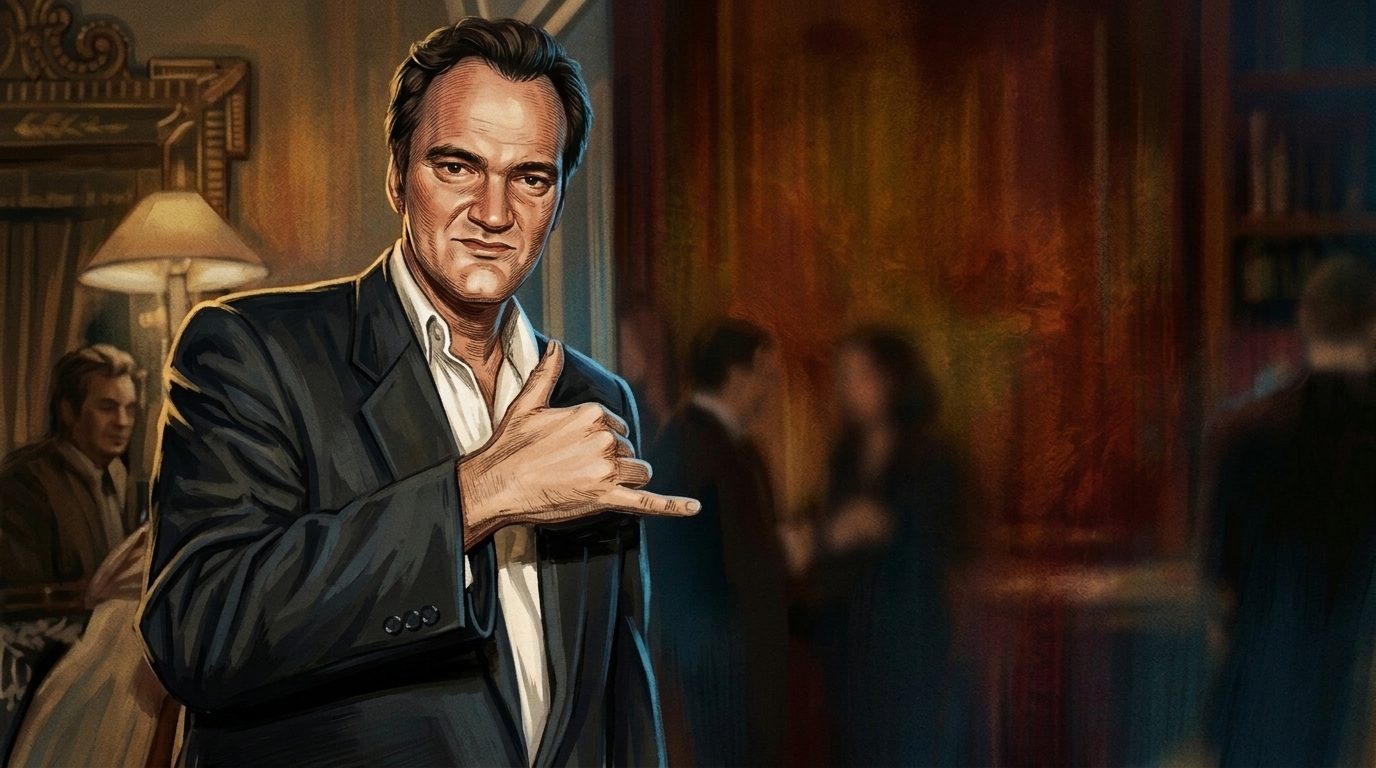
Quentin Tarantino says he directs ten films and stops. The script for number ten is already written and sitting in a drawer. If he keeps that promise, the smartest version of his last act is not him behind the camera at all. It is him writing and handing the pages to someone who cuts harder than he would.
That version already exists. It premiered Monday.
A 230-page problem Tarantino couldn’t solve alone
The Further Mis-Adventures of Cliff Booth opened at the TCL Chinese Theatre on Nov. 16, full reviews held until Thursday. What leaked out first was not praise for a shot or a set piece. It was praise for a voice.
TheWrap’s Drew Taylor called it “an absolute triumph. The best.”
https://x.com/DrewTailored/status/2122567676589752608
Variety’s Clayton Davis called it “a wild, hilarious hangout movie.” A hangout movie lives or dies on dialogue. Pointing a camera at Brad Pitt is the easy part.
Here is the fact that makes the case. Fincher told Empire the first draft he read ran 230 pages and was “essentially two movies.” He cut 60 of them and landed at roughly two hours and 20 minutes.
Tarantino explained his own method in the same conversation. “I take these giant novels I write and I adapt them into a movie every single solitary day of the shoot,” he said. On this one, that adapting happened before a single camera rolled, in six to eight weeks of what Fincher called “Defend your life” rehearsal.
Tarantino warned him the assembly would run four and a half hours. Fincher’s reply: “I have an assembly. It’s two hours and 18 minutes.” Tarantino’s own verdict on what survived: “I don’t think there’s a scene that I wrote that’s not in the film.”
That is compression, not deletion. A writer is the worst person to judge which of his own ten pages about a car radio are load-bearing. Fincher is the right one.
Why this director and not the last one who tried
The obvious objection is history, and it is a bad one for Tarantino. The last time he handed a script to a major filmmaker, Oliver Stone rewrote Natural Born Killers with David Veloz and Richard Rutowski and Tarantino walked away with a story credit and a movie he still hasn’t finished watching.
Fincher’s stated priorities are the opposite of what Stone did to that script. “I think of myself as an interpreter. The number one person I want to make happy in any cinematic experience is the writer,” he told Empire, ranking actors second, himself third, the studio last.
That is not flattery. It is a production philosophy that’s already been road-tested. This is Fincher and Pitt’s fourth film together, after Se7en, Fight Club and The Curious Case of Benjamin Button, and Leonardo DiCaprio called Fincher “the perfect man for the job” even while explaining why his own cameo fell through. The deal closed on a text. Netflix’s Ted Sarandos told the premiere crowd he greenlit the film on eleven words from Fincher: “Written by Quentin Tarantino. Directed by David Fincher. Starring Brad Pitt.” No IP math, no fourth name attached.
The trophy case backs this up too. Tarantino has two Oscars, both for original screenplay, and three directing nominations with no win. The Academy has been telling him which half of the job is his for thirty years. He’s started saying it himself. “I’m just a writer and that’s just kind of what I do. I’m always writing,” he said at AFI Fest in October. The novel version of this same story lands from Harper on Dec. 8. Same material, no camera required.
Anyone deciding what to queue up before the Imax run should start with the first film, and this list of what to watch before the Nov. 25 release covers it, along with the 1977 crime-story setting the new trailer leaned into.
The fair pushback
Here’s where the other side gets its due. Tarantino’s own staging is the reason the 2019 film worked, not just the dialogue. Nobody but Tarantino builds the drive up to Spahn Ranch as a western episode smuggled into 1969, and critics noticed: Peter Bradshaw wrote of “the crazy bravura of Tarantino’s film-making.” A script is not a movie. Somebody has to decide which of the writer’s pages actually belong on screen, and that somebody is a director, not an editor.
Tarantino knows this better than anyone. His reason for stopping at ten was never fatigue. “I just don’t want to be an old-man filmmaker,” he told Playboy back in 2012. The tenth film is the one he’s protecting.
The one more film
The script is written. The play comes first. “I’ve written a script that I really like, but I want to do the play and see who I am,” he said on The Graham Norton Show, with family time promised after that.
So let the sequencing argue for itself. Send the next big one to a director who cuts 60 pages in a rehearsal room and still calls himself the writer’s employee. Save the tenth, the one he’s been protecting since 2012, for the single film where only his own hands on the camera will do.