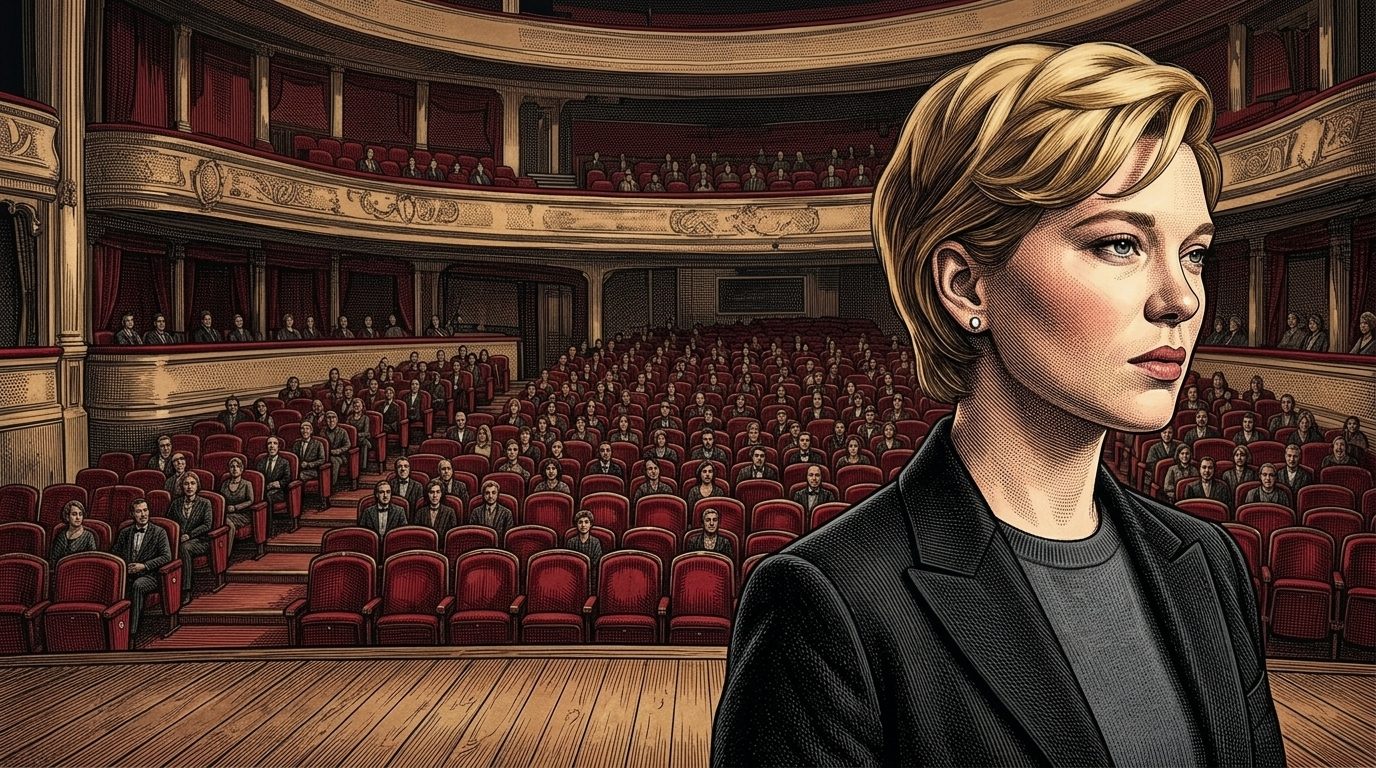


Paper Tiger is a Skip It for the theater and a Stream It for anyone who already knows James Gray’s name, which is really the whole review in one sentence. It is a real crime picture about a poisoned version of the American dream, shot with care and acted with conviction, and it was sold to a Thanksgiving crowd that did not ask for it.
The numbers say as much without Mark Delaney needing to editorialize. Neon pushed the film from 28 theaters to 1,332 on the Wednesday before Thanksgiving, and Deadline logged the holiday gross at $340,000, tracking toward roughly $3 million for five days on a movie budgeted at $15 million). The same report clocked a C+ CinemaScore and a 66 percent audience score, which it summarized in four flat words: “Not an audience pleaser.” Rotten Tomatoes shows the split in sharper relief, 88 percent from critics against 67 percent from the public, the exact shape of a movie that plays beautifully at a festival and stiffly at a mall.
The plot, briefly, is a family eating itself. Irwin Pearl is an engineer with a wife, two sons and a quiet grudge against his own modesty. His brother Gary, an ex-cop with a Mercedes and a proposition, pulls him into a consulting job on the Gowanus Canal cleanup, working for Russians Gary insists are scientists and engineers, which is the film’s whole argument in one euphemism. Teller, Driver and Johansson play the family across that triangle, and the picture turns on which of them believes their own cover story first. (The family splurges on Peter Luger takeout, which Gray films as both generosity and bribe, and does not bother telling the audience which one it means.)
The single choice that makes the case for this being a real James Gray film rather than a star vehicle in a trench coat is the cinematography. Gray shot it on 35mm with cinematographer Joaquín Baca-Asay, underexposed by a stop and in 2-perf, chasing a grain and a warmth from inside the frame that Baca-Asay describes as “the golden aging of death: sepia tea stain,” adding, pointedly, that Gray “hates blue.” That texture pays off hardest in a chase through a tall wheat field, Gary weaving through the stalks while his pursuers enter the same maze, the camera alternating between inside the grass and high above it, a sequence Deadline compared to the cropduster run in North by Northwest. For those few minutes the dread the screenplay keeps announcing becomes a physical place a man cannot walk out of, which is the kind of filmmaking a plot hole cannot undo.
This is Gray’s ninth feature, and it started life as a sequel to Armageddon Time, with Anne Hathaway and Jeremy Strong cast as his parents before both actors became unavailable and he recast the roles with Scarlett Johansson and Teller, pushing the script toward heightened melodrama. Where it lands feels closer to Little Odessa and The Yards than to Ad Astra, a family drama wearing a crime plot as a coat rather than a costume. The DNA shows: Gray is still making movies about men who mistake a family obligation for an escape route, and the only thing that has obviously changed since his earlier pictures is the size of the budget.
The reviews split along the same line as the audience numbers. IndieWire’s David Ehrlich called it “a career-best” turn from Driver, and The Hollywood Reporter’s David Rooney filed it as “a drama of almost overwhelming power”. Owen Gleiberman admired the mood and not the mechanics, writing that Gray remains “an ace director who’s still being undercut by the holes in his screenplays”, and Richard Brody, warm on the atmosphere, still concluded flatly that “it’s not a film of ideas.” All four are correct about the same film, which is exactly why selling it as a star-driven thriller was always going to backfire.
Anyone who bought a ticket expecting a clean third act with a satisfying click at the end will be checking the runtime in the back half, and that viewer has not failed to appreciate the movie so much as been sold the wrong one. Teller does decent, overeager energy close enough to the Albert Brooks of Lost in America that Ehrlich’s comparison lands as a compliment. Johansson holds the family’s quietest, most skeptical register, the one person totting up a cost the men around her refuse to see. Driver gets the showiest part, a man who has fully bought his own pitch, and he is the reason the movie’s back half holds even when the screenplay stops building.
Neon bought the film before its Cannes premiere, where it drew a standing ovation Deadline timed at ten minutes, and it later opened the New York Film Festival in September, which is a lot of pedigree for a movie that then had to compete with a Hunger Games rerelease over a holiday weekend. Gray himself seems unbothered by any of it, telling the Marrakech festival that competition circuits are “ethically, morally bankrupt” before adding, “it’s not sports, you know?” He is not wrong, and that attitude is also why this film was never built for a wide Friday opening in the first place, a point the site made when it listed Paper Tiger among this weekend’s four best watches back when it was still playing on six screens.
Paper Tiger will read better in five years than it does in a 1,332-theater wide release, because what is wrong with it is a screenplay Gray has never been interested in tightening, and what is right with it is the reason his admirers keep showing up (this site’s own earlier take went further and called it his best film yet). Skip the theater unless a 35mm print is still running near you. Everyone else should wait for the couch, where a bleak family noir loses nothing and the Thanksgiving crowd it was never meant for finally stops mattering.