
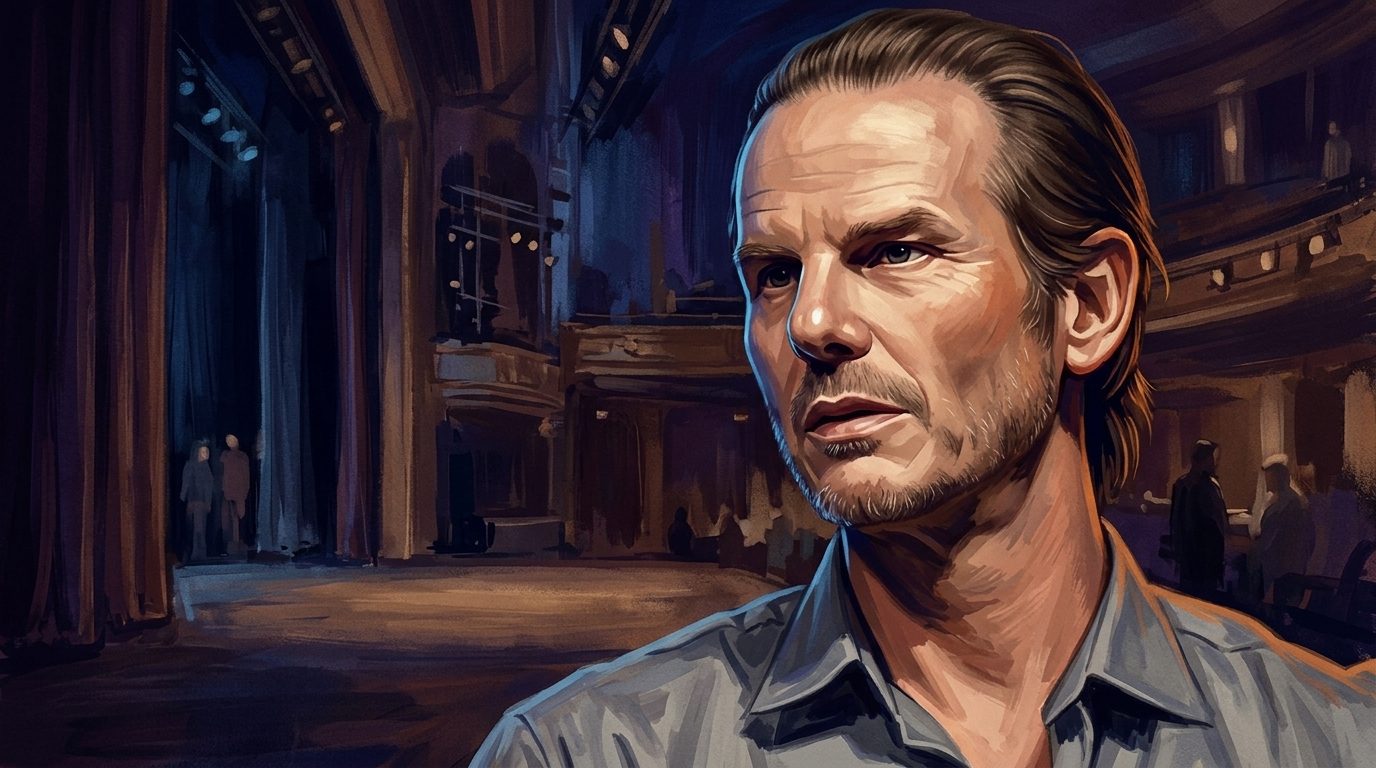
The Mosquito Bowl is worth the two hours on a couch, provided the viewer accepts the movie Peter Berg actually made rather than the one his trailer advertised. It opened in theaters Oct. 30 and reaches Netflix on Nov. 25, and the streaming window suits it, because the first hour is some of the most alive filmmaking Berg has managed in years and the second settles for noise where it needed character.
The source is Buzz Bissinger’s 2022 book, and the game it chronicles is not a Hollywood invention. Marines from the 4th and 29th Regiments played a scoreless Christmas Eve game on Guadalcanal in 1944, with 1,500 spectators, printed programs and a radio call, and fifteen of the 65 players died at Okinawa, three of the film’s four subjects among them. That ratio, not the football, is what the picture is actually about.
Ray Nicholson plays Tony Butkovich, the Purdue back the Cleveland Rams drafted in the first round, and he is the reason the first hour works at all. He gives the role the strut of a man who has never lost anything, the locker-room boast, the grin that lands a beat too late, an easy cruelty toward teammates he outruns. Whats On Netflix named him the film’s MVP, and that is the correct call even allowing for the Guardian’s dry observation that he has “inherited his father’s wild eyes but less of the magnetism,” which is a fair price to pay for being the son of Jack Nicholson and a backhanded compliment Berg’s film mostly earns him anyway.
The single best decision in The Mosquito Bowl is how it shoots combat, and it is the one choice that does the work the screenplay later skips. Berg and cinematographer Jacques Jouffret keep the camera tight, low and handheld, so battle arrives as half-information: a friend cut off mid-sentence, a flamethrower swinging through smoke, a ridgeline nobody can actually see over. Variety describes the palette as “aggressively desaturated,” and Explosions in the Sky, reunited with Berg after Friday Night Lights, keep a guitar line shimmering under the worst of it rather than scoring the carnage directly. Berg told CBS News he wanted the combat to feel “as hard and as intense as I could possibly make it,” and on a shot-by-shot level, the film delivers exactly that. The cost is that the technique starts carrying weight the script never builds toward, which is why Variety’s Guy Lodge calls the overall effect “almost heartless” even as the craft underneath stays genuinely impressive.
https://www.youtube.com/watch?v=CPFkLjHfKoc
What the film refuses is worth crediting on its own terms. There is no general’s speech framing the cause as glorious, and the closing title cards name the Japanese civilians killed at Okinawa alongside the war’s broader toll. Berg has said the point was to remind audiences “there’s no glory in war,” and Deadline’s Pete Hammond went as far as calling it “one of the most effective antiwar films I have ever seen.” That is a real swing, and the film mostly lands it in the first hour.
Then the back half arrives and the screenplay, credited to Berg and Mark L. Smith, stops building anything. IndieWire clocks the title game itself as an eight-minute montage, and The Hollywood Reporter notes it “finally arrives with almost no build-up at all.” By the third firefight the deaths feel interchangeable rather than earned, which is the gap between staging grief and writing it. Part of the thinness traces to a documented liberty: Butkovich actually served with the 29th Marines while his three co-leads were 4th Marines officers, so the film folds all four men into one outfit, with Variety noting the dates are “lightly fudged” to keep them together as a unit worth following.
For Berg this sits between the two halves of his own career. He adapted Bissinger’s Friday Night Lights into the 2004 film and later the series, and the two men are cousins, which makes this a family project twice removed. The years since went to Lone Survivor, Deepwater Horizon and Patriots Day, the run of true-story war and disaster films this one most resembles, and his father was a Marine in the Korean War now buried at Arlington, which is presumably why Berg cast himself as the commanding general who tells his men it will not get easier. The Mosquito Bowl lands as the most technically assured of that run and the least dramatically filled in.
Lone Survivor and Patriots Day loyalists will find plenty here, and WWII completists will want the whole picture regardless of its second-half sag. Anyone who watched the trailer and expected a football movie will be checking the runtime by the ninety-minute mark, and viewers who want a war film to earn its grief scene by scene, rather than borrow it from the historical record, will notice the screenplay doing less than the camera.
The Mosquito Bowl is Stream It, a sincere and handsomely shot tribute that gets about halfway to the film it was reaching for, carried the rest of the way by Ray Nicholson and a battlefield that never once looks easy.